

Last Updated: October 25, 2026
Quick Summary
Premium wooden jigsaw puzzles are worth it for adults because thicker wood stock, precision-cut pieces that hold their fit, and accurate color reproduction outlast cardboard puzzles. Compare brands on six criteria: wood thickness, piece fit, color fidelity, cut style, finished dimensions, and damage policy. Match piece count and cut style to your skill level before buying.
- Premium stock runs roughly 3 mm to 6 mm thick; thinner stock flexes and chips.
- Starz Puzzles works with more than fifty artists contributing roughly 350 original artworks.
- Beginners should start with roughly 100 to 250 pieces and clear color zones.
- A 500-piece puzzle with large single-color blocks is harder than a varied 750-piece one.
- Email the brand asking wood thickness and missing-piece policy before ordering.
Table of Contents
- What Makes Premium Wooden Jigsaw Puzzles Different
- Wooden Jigsaw Puzzles With Unique Shapes and Whimsy Cuts
- How to Compare Wooden Jigsaw Puzzle Brands
- High-Quality Jigsaw Puzzles for Adults: Matching Difficulty to Skill
- Durability, Care, and Long-Term Value
- Choosing Your First Wooden Puzzle From Starz Puzzles
- Frequently Asked Questions
What Makes Premium Wooden Jigsaw Puzzles Different
Premium wooden jigsaw puzzles for adults differ from cardboard puzzles in three measurable ways: thicker wood stock, precision-cut pieces that hold their fit, and printing methods that preserve an artist's original color. At Starz Puzzles, we produce each puzzle to order using a patented reproduction process, which is why the image you receive matches the artwork you selected.
The gap between a mass-market puzzle and a premium one shows up on day one and again five years later. Cardboard softens at the edges and delaminates after repeated handling. Wood does not.
Wood Quality, Thickness, and Piece Fit
Wood quality is the single biggest predictor of how a puzzle feels in your hands and how long it lasts. Denser wood holds a cleaner cut, resists warping, and keeps piece edges sharp instead of fraying.
Piece fit follows directly from cut precision. A well-cut puzzle clicks together with light pressure and stays put when you lift a section. Loose, sloppy fits usually trace back to thin stock or dull tooling.
Artwork Reproduction and Color Fidelity
Color fidelity is where most puzzle buyers get burned, and it's the complaint we hear most often.
Our approach is different by design. We work with more than fifty artists who contribute roughly 350 original pieces of artwork, and our patented process reproduces each creation without compromising color or detail.
That matters because a puzzle is a reproduction of someone's painting or illustration. If the reproduction is dull, you're assembling a dull version of good art.
Wooden Jigsaw Puzzles With Unique Shapes and Whimsy Cuts
Wooden jigsaw puzzles with unique shapes are defined by their cut style: instead of a uniform grid, the die includes irregular edges and whimsy pieces shaped like objects, animals, or figures that appear inside the puzzle.
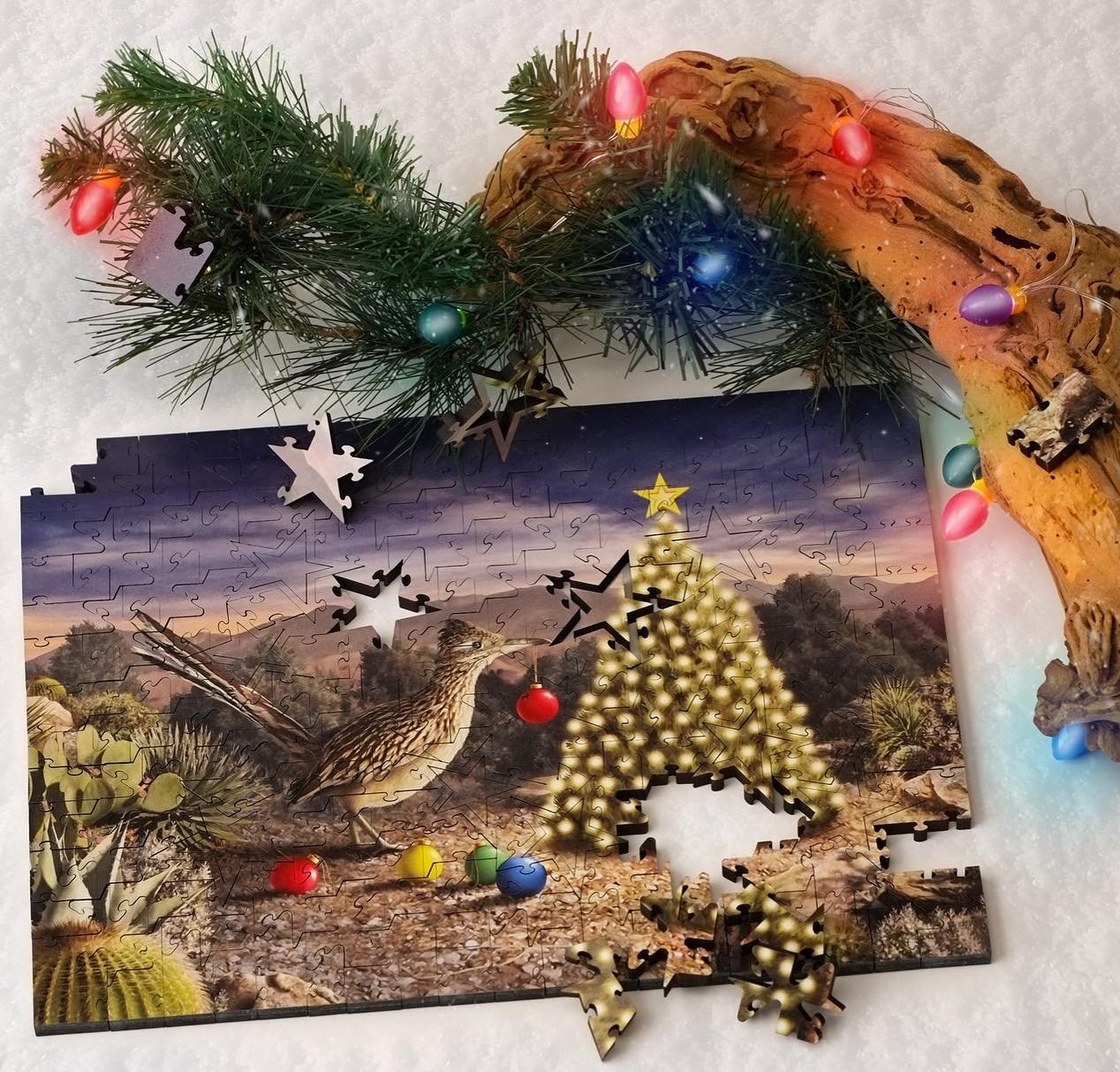
Diagram illustrating the complex assembly process of wooden jigsaw puzzles with unique whimsy-shaped pieces.
Whimsy cuts are the feature experienced puzzlers ask about first. A piece shaped like a bird or a key doesn't just add charm; it gives you a mental landmark while you work. Beginners sometimes find them disorienting at first.
The trap with unusual cuts is thin wood. A delicate whimsy piece cut from flimsy stock snaps.
How to Compare Wooden Jigsaw Puzzle Brands
Comparing wooden jigsaw puzzle brands comes down to six checkable criteria: wood stock and thickness, cut precision and piece fit, color reproduction, cut style, completed dimensions, and how the maker handles damage or missing pieces. Ask about all six before you buy from anyone.
Most shoppers compare artwork first. That's backwards. Artwork is the reason you pick one puzzle over another; construction is the reason you keep buying from a brand.
Side-by-Side Buying Comparison
Use this table as a shopping checklist. Fill in the numbers for each brand you're considering, the point is to compare like for like instead of browsing separate product catalogs.
Criterion |
What to Check |
Typical Range to Expect |
Why It Matters |
|---|---|---|---|
Wood stock |
Density and thickness |
Roughly 3 mm to 6 mm for premium stock; thinner stock flexes and chips |
Determines durability and piece snap |
Cut precision |
Test-fit a section; check for sawdust residue |
Pieces should click with light pressure and hold when lifted |
Loose fits signal dull tooling |
Color reproduction |
Compare to the artist's original or a high-quality proof |
Look for saturated midtones and clean edges, not washed-out gradients |
Cheap printing dulls detail |
Cut style |
Grid vs. irregular edge vs. whimsy pieces |
Grid is easiest; whimsy and irregular edges raise difficulty |
Sets difficulty and replay value |
Completed dimensions |
Measure the finished size, not the box |
Small puzzles run roughly 8 x 10 in; large ones can exceed 20 x 28 in |
Determines table space and framing options |
Damage policy |
Missing-piece and damage terms |
Look for a stated replacement window and a clear contact channel |
Protects your purchase |
A common mistake is judging a brand by its product photos alone. Ask instead how the puzzle is produced. If a brand can't tell you its wood thickness or its replacement policy in plain language, that silence is itself a data point.
Pricing is the other honest question. Wooden puzzle prices vary widely with artwork, size, and piece count, so check the current price on the specific design you want rather than trusting a category page. What you're paying for is the wood, the cut, and the color fidelity, not the box.
High-Quality Jigsaw Puzzles for Adults: Matching Difficulty to Skill
High-quality jigsaw puzzles for adults should match your skill level, not flatter it. Four variables drive difficulty more than any other factor: piece count, image complexity, edge style, and cut style.
Here's how the variables interact, and how we'd sort buyers:
- New to wooden puzzles: Lower piece counts, roughly 100 to 250 pieces, with artwork that has clear color zones and recognizable subjects. Landmarks make early progress feel rewarding.
- Casual weekend puzzler: Mid-range piece counts, roughly 250 to 500 pieces, with moderate visual complexity. Enough challenge to fill an evening, not enough to stall.
- Experienced puzzler: Higher piece counts, 500 pieces and up, with fine detail and dense whimsy cuts. Large areas of similar color are the real test.
- Family and group work: A puzzle with distinct color sections lets several people work at once without crowding one area.
Visual complexity is the variable people underestimate. A 500-piece puzzle with large blocks of a single color is far harder than a 750-piece puzzle with varied color and clear subjects.
Cut style changes difficulty independently of piece count. A standard grid cut gives you straight edges and predictable rows. An irregular edge removes the border as a starting point.
Accessibility and Ergonomic Considerations
Most buying guides ignore the puzzler's hands and eyes. If you're buying for an older adult or someone with limited dexterity or vision, four practical factors matter:
- Piece size: Larger pieces are easier to grip and place. Lower piece counts usually mean larger pieces for the same finished dimensions.
- Visual contrast: High-contrast artwork with distinct color zones is easier to scan than low-contrast or monochrome images.
- Surface finish: A matte or low-glare finish reduces eyestrain under overhead lighting better than a glossy one.
- Table setup: A puzzle board or felt mat with a raised edge keeps pieces from sliding and makes it easier to work in short sessions.
Durability, Care, and Long-Term Value
Durability is what separates a puzzle you do once from one you pass down. Wood puzzles resist spills and fading in a way cardboard cannot, and a well-made wooden puzzle can be assembled, taken apart, and stored for years without losing its fit.
Care is simple:
- Store pieces in a dry space, away from direct sun.
- Keep the completed puzzle off damp surfaces.
- Handle pieces by the edges when you can.
- Keep the original box or a flat container for storage.
Long-term value comes from reuse. A puzzle that survives twenty assemblies is a different purchase than one that survives two. This is also where a missing-piece guarantee matters: a lost piece shouldn't end a puzzle's life.
For families, that durability changes the math. A spill-resistant puzzle that survives toddlers and holiday gatherings earns its place in the closet.
Choosing Your First Wooden Puzzle From Starz Puzzles
Choosing your first wooden puzzle is easier when you start with artwork you genuinely love. Pick a design you'd hang on a wall, note your experience level, and let the piece count follow from there.
Start with these steps:
- Browse our artist collection and save two or three designs you love
- Match piece count to your experience level
- Decide whether you want standard or whimsy cuts
- Check current pricing and production time on our site
- Order with enough lead time if it's a gift
Production time matters for gifts. Because each puzzle is crafted individually upon order, printed fresh and then packaged for shipping, we recommend ordering well ahead of your date. If you're buying for a birthday or holiday, build in a buffer.
Frequently Asked Questions
Are wooden jigsaw puzzles better than cardboard puzzles?
Wooden jigsaw puzzles last far longer than cardboard. Cardboard warps with humidity, peels at the edges, and loses piece fit after repeated use. Wood holds its shape, resists spills, and keeps cut precision over years. The trade-off is price: wooden puzzles cost more because of the material and the cutting process. If you plan to do a puzzle more than once or pass it down, wood is the better long-term buy.
What should I look for in a high-quality wooden jigsaw puzzle?
Check four things: wood thickness and grain, cut precision (pieces should fit snugly without forcing), color reproduction of the artwork, and whether the maker uses original artist work. Ask about the piece count and whether whimsy shapes are included. A missing-piece guarantee and clear return policy also signal a maker that stands behind its product. These details separate premium wooden jigsaw puzzles from budget imports.
What makes a wooden jigsaw puzzle worth the price?
The price reflects materials, cutting time, and artwork licensing. A puzzle cut from quality wood with original art costs more to produce than a mass-printed cardboard one. You are also paying for durability: a wooden puzzle can be assembled dozens of times without wear. If you want a gift that lasts or a puzzle you will revisit, the cost per use drops sharply over time.
Which wooden puzzle brands offer the most distinctive piece shapes?
Brands that use whimsy cuts, irregular edges, and figural pieces stand out. Starz Puzzles offers wooden jigsaw puzzles with unique shapes cut from original artwork by more than fifty artists. Distinctive shapes add difficulty and make the completed puzzle a display piece.
The real challenge with wooden puzzles isn't finding one. It's finding one built well enough to keep. Starz Puzzles works with over fifty artists, offers roughly 350 original artworks, and prints each puzzle to order using a patented process that preserves color and detail, with puzzles designed to resist spills and fading for a lifetime of assemblies. Get started with Starz Puzzles and choose artwork you'll want to assemble more than once.

0 comments